
 EN
EN

New Cooling Solution for Temporary Site Cabins: Construction Record of the Maoming Project
Time : 2026-09-07
Temporary site offices on engineering and construction projects are often harder to endure in summer than permanent buildings. Color steel sheet prefabricated structures conduct heat quickly and store it intensely; as soon as the sun hits them, indoor temperatures frequently exceed 40°C, and even air conditioners set to maximum struggle to bring effective cooling, making the working environment stifling and uncomfortable.
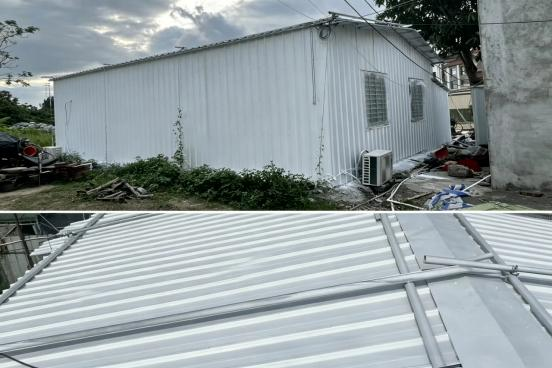
Recently, a project team stationed in Maoming, Guangdong, completed the spray application of radiative cooling coating on the temporary office housed in a color steel sheet prefab. This marks a practical deployment of radiative cooling technology in construction site temporary facilities.
Recently, a project team stationed in Maoming, Guangdong, completed the spray application of radiative cooling coating on the temporary office housed in a color steel sheet prefab. This marks a practical deployment of radiative cooling technology in construction site temporary facilities.
Color steel sheet prefab structures are standard temporary facilities on construction sites, but the thermal performance of metal roofs has inherent shortcomings. Low thermal resistance and low solar reflectance allow large amounts of solar heat to pour into the interior. Maoming is located in western Guangdong, where summer conditions are hot and humid, making the problem more pronounced when color steel sheet prefabs are exposed to direct sunlight. In summer, color steel sheet roof temperatures can reach 50–60°C or even higher. After the application of reflective thermal insulation coatings, the roof surface temperature drops significantly – by over 25°C – with interior temperatures reduced by 6–15°C. The application of radiative cooling coatings is precisely intended to address this situation.
Working Principle of Radiative Cooling Coating
The core mechanism of radiative cooling coating consists of two aspects:
High solar reflectance: The coating has a high reflectance for solar radiation (including ultraviolet, visible light, and nearinfrared), reducing heat absorption at the source.
Efficient radiative heat dissipation: The coating continuously emits heat in the form of infrared radiation through the “atmospheric window” band (8–13 μm) into outer space, achieving passive cooling.
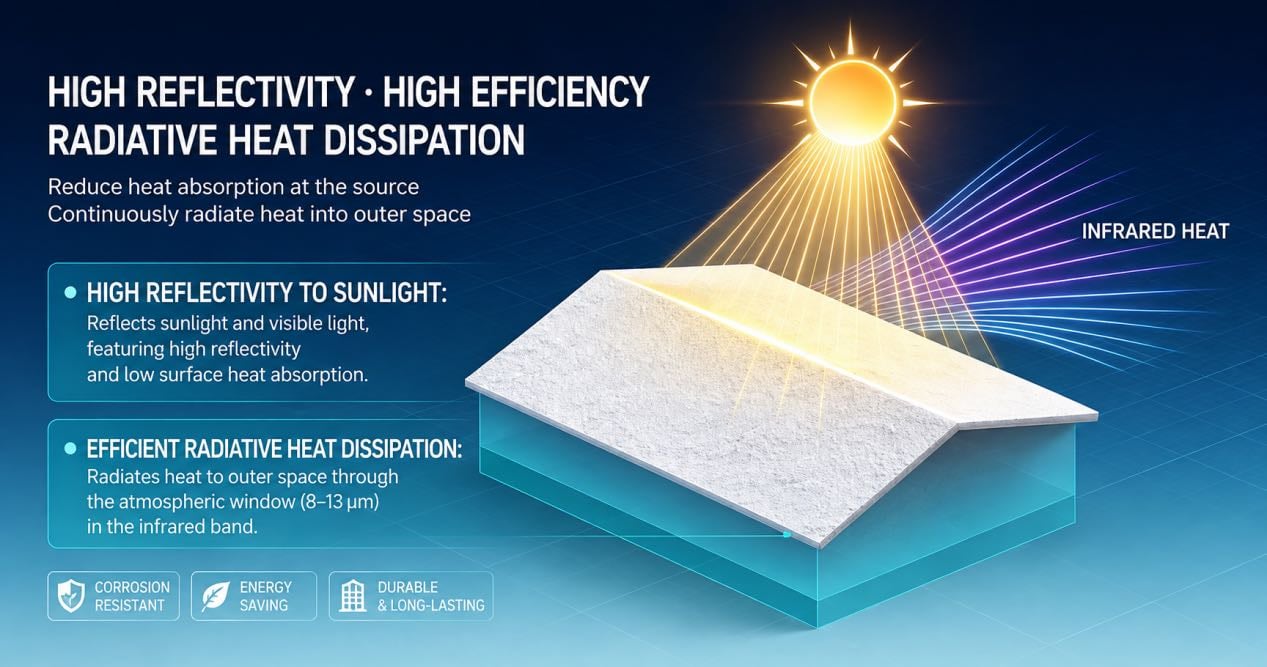
Unlike traditional insulation methods, radiative cooling coating not only “blocks” heat but also actively “dissipates” it, and the entire cooling process consumes no electricity.
Key Construction Points for Color Steel Sheet Prefabs
Construction on color steel sheet prefabs is straightforward. The main steps are as follows:
Substrate preparation: Remove oil stains, dust, and standing water from the surface of the color steel sheets; grind rusted areas to ensure the substrate is clean, dry, and sound.
Coating application: Apply the coating evenly by roller or spray in two coats, with each coat at approximately 0.12–0.15 kg/m². Wait until the previous coat is completely dry before applying the next.
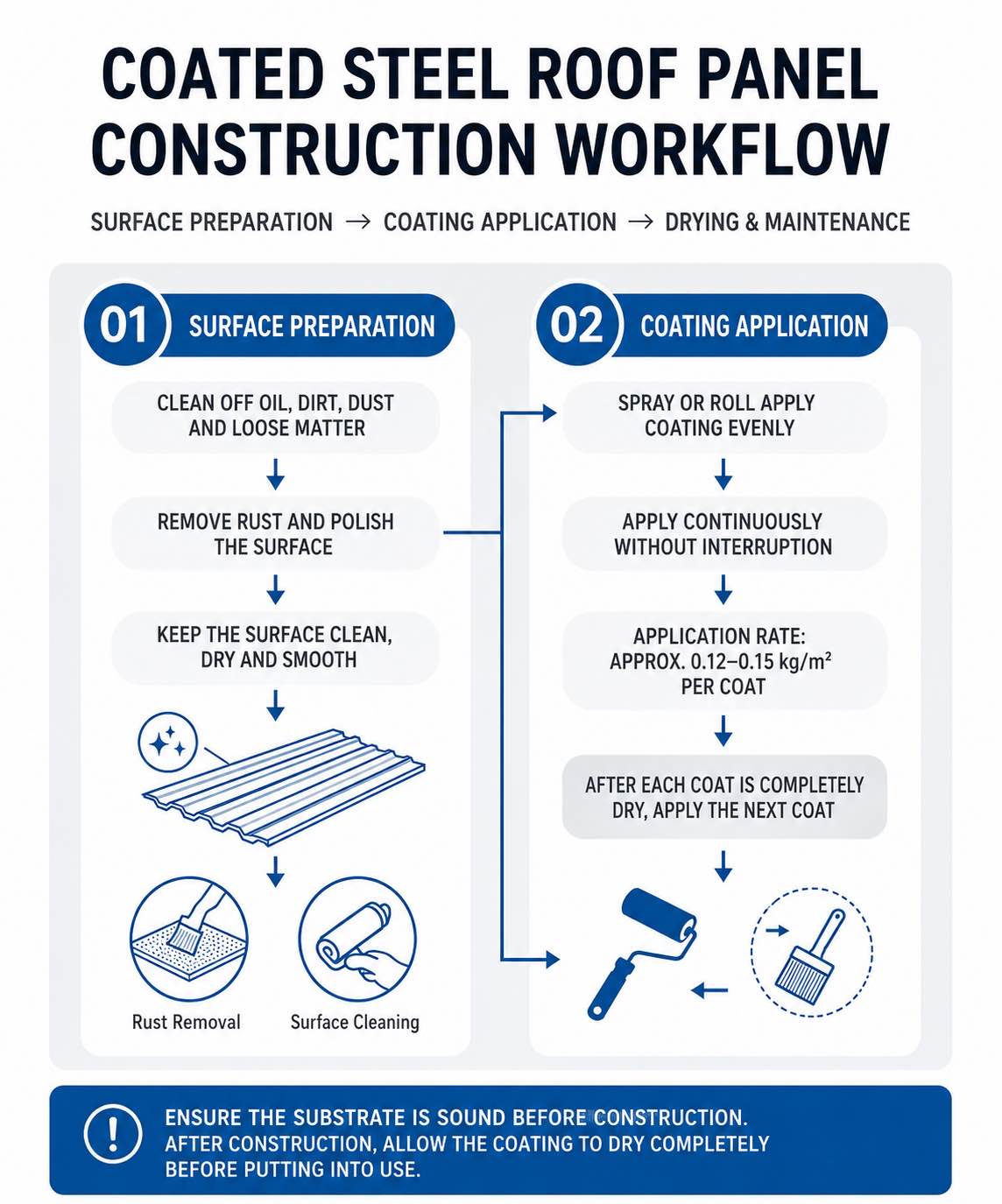
Curing and Film Formation: After construction, allow the coating to cure for 24 hours, during which contact with water should be avoided.
Application Conditions: Humidity below 85%, air temperature above 10°C. Avoid construction on rainy days.
Reference Results from Similar Projects and Product Data:
After applying radiative cooling coating to color steel sheet prefabs, the following improvements can be expected:
Roof surface temperature is reduced compared to preconstruction levels. Indoor temperature is lowered, and the stuffy feeling in the working environment is alleviated.
Airconditioning load shows observable reduction, contributing to electricity savings.
For temporary site offices, this means more comfortable working conditions and more controllable electricity costs.
The cooling challenge of temporary offices in color steel sheet prefabs does not necessarily have to be solved by replacing the structure. Radiative cooling coating offers an auxiliary heatdissipation solution that is easy to apply, consumes no electricity, and requires no maintenance – reducing external heat ingress and making summer in temporary site buildings far more bearable.